
Interview / english version below
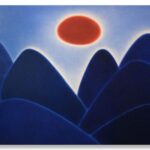
Liebe Sol, Deine zweite Soloshow bei FWR Galerie trägt den Titel Everybody Knows This Is Nowhere. Dies ist auch der Titel einer Malerei in der Ausstellung, einem Mittelformat, das von kreisförmig angeordneten Dreiecksformen in dunklen Blautönen geprägt ist. Es könnten die Silhouetten von Bäumen oder Bergen sein. Mittig glüht eine Art Lichtung im magischen Übergang von Gelb Orange-Rosé. Der Titel greift Neil Youngs bekanntestes Album (1969) auf. Inwiefern ist Musik für dieses Bild und deine Arbeit im Studio inspirierend?
Ich höre meistens Musik ohne Text, wie z.B. Ambient Musik, cinematische Musik und Klassik, um eine Atmosphäre für ein Bild und im Atelier zu inszenieren. Dann beginne ich ein Bild mit einer passenden Farbe, die zur Stimmung passt, ohne Vorlage. Tagelang, wochenlang schaue ich mir das Bild an und fülle es Schritt für Schritt. Ich male mal schnell und mal langsam und lost. Das Bild mit dem Ausstellungstitel stand lange in einer Ecke im Atelier. An einem Abend habe ich das Album Everybody Knows This Is Nowhere von Neil Young auf dem Schallplattenspieler meines Freundes gehört. Als ich dem Lied mit demselben Titel lauschte, ist mir das „verlorene“ Bild eingefallen, und auf einmal hatte ich einen Titel dafür. Genauso sind meine Malereien keine Abbildungen von einem bestimmten Ort, sondern ein Raum, wo gesehene Landschaft eine neue erschafft. Ein Ort, der existiert, aber nicht wirklich ist. Der Titel des Lieds hat quasi bei mir „angeklopft“. Und so verwandelt sich manchmal ein Wort, ein Satz oder eben ein Liedtitel in ein Bild.
Vor deinen Bildern stehend gerät man ins Träumen. Was sich auf den ersten Blick als Landschaft präsentiert – hier ein See, dort Bäume, Büsche, weiters Himmel, Sonne, Mond -, wirkt beim zweiten Hinschauen unwirklich. Himmel und Meer tragen spiegelbildlich dasselbe Blau, oder Sonne und Mondsichel stehen zeitgleich in einem karminroten Farbgrund, ein perlenartiges Band schiebt sich vor den Horizont. Woher nimmst du deine landschaftlichen Impressionen? Und wie kommt es zu den surrealen Momenten in deiner Bilderwelt?
Ich nehme oft die Landschaften als Bildmotive, die ich gerne betrachte. In meiner Heimat Chuncheon in Korea sehe ich die Berge aus dem Fenster. Egal, wohin ich laufe, stehen die Berge um mich herum, während die Stadt mit Gebäuden, Autos, Straßen und Menschen voll ist. Natur wirkt hier wie eine Leerstelle. Und so kann mein Blick abseits der Hektik der Stadt sich ausruhen auf den Bergen, den Bäumen, dem Meer und dem Himmel. Auch auf meinen Reisen suche ich die Ruhe der Landschaft, fern vom Lärm. Ich mache oft Fotos von Ausschnitten des Himmels, dem Panorama. Immer wieder finde ich neue, ungewöhnliche Perspektiven und erlerne dadurch die Dynamik der Linien, neue Farben und Formen. Bilder vom Tag, Bilder in der Nacht – ich sammle verschiedene, und aus den Afterimages entsteht dann eine neuartige Landschaft. Vielleicht entsteht dadurch der surreale, entrückte Eindruck.
Dein Farbauftrag ist besonders. Du gibst die Ölfarbe auf die pure Leinwand, in nur einer Berührung. Es ist ,als ob deine Malerei „atmet“. Haben dein Handwerk und die daraus resultierende Ästhetik womöglich Verbindungen zur koreansichen Malerei – oder auch dem Film, Mode?
Früher hatte ich keine Kenntnisse über koreanische Malerei. Seit ich in den USA und Deutschland Kunstmuseen besucht und die westliche Kunst erlebt habe, fand ich erst meinen Geschmack heraus. Danach habe ich oft Ausstellungen der koreanischen alten und modernen Malerei in Korea besucht, um die Kunst meiner Herkunft aus neuen Perspektiven zu betrachten. Die Materialien der traditionellen koreanischen Malerei sind Wasser, Muk (Tusche) und koreanisches Papier. Die Pinselstriche werden in einem Zug entschieden. Die Stellen, die nicht bemalt werden, bleiben leer und trocken. Die Leere ist ein wesentlicher Teil der Komposition, da sie das Bild atmen lässt. Es ist eine entschiedene Malerei, die entleert und dadurch gefüllt ist. Durch das Anschauen solcher Werke habe ich das Füllen und Leeren, und den Charme der trockenen Oberfläche des Bildes kennengelernt. Seither bin ich in die moderne Malerei von Lee Ufan, Yun Hyong-keun und Yoo Young-kuk verliebt. Sie ist ruhig, dramatisch, schlicht und pathetisch. Ich möchte auch solche Bilder malen, die das Essentielle zur Sprache kommen lassen.
Deine Bildkompositionen oszillieren zwischen Figuration und Abstraktion. Anlass für diese Indifferenz ist deine auffallend minimalistische Formensprache. Visuelle Unschärfen lassen Vorder-und Hintergrund sowie die Grenze zwischen Farbe und Motiv verschwimmen. Alles im Bild wirkt losgelöst von Raum und Zeit. Folgst du in deiner Bildgestaltung einem zuvor festgelegten Konzept, gibt es Vorstudien? Oder lässt du dich in einem intuitiven Prozess leiten?
Mein jüngstes Reiseziel wird oft zum Motiv für eine neue Werkreihe. Es können Berge, das Meer, ein Garten, der letzte Sonnenaufgang oder auch nur eine Hecke oder ein einzelner Vogel am Himmel sein, die ich zuletzt beeindruckt angeschaut habe. Ich male ohne Skizzen oder Zeichnungen als Vorlage. Das Malen ist für mich keine Aufgabe, bei der ich festen Vorgaben folge, sondern ich erlaube mir die Zeit für einen freien Ausdruck. Beim Malen wird die erlebte Landschaft von mir innerlich verarbeitet. Manchmal dauert es bei einem Bild zwei Tage oder mal ein halbes Jahr. Jedes Bild hat sein eigenes Tempo. Im Lauf des Prozesses kann das eigentliche Bildmotiv in der Farbe verschwinden, die Grenze zwischen Vorder- und Hintergrund verunklaren, und dadurch ein neuers Zeit-/ Raumkontinuum auf der Leinwand entstehen. Durch den langsamen und konstanten Prozess sehe ich schließlich, wie meine Malerei das Bild formt.
Deine Malerei wirkt wahrhaftig und tief ergreifend. Angesichts deines wiederkehrenden Motivs von der „Welle“ fühlte ich mich erinnert an eine Erzählung der koreanischen Dichterin Han Kang: „(…) In der Entfernung wirkt das Meer eher gleichmäßig bewegt, und die Wellenkämme erinnern an die Schuppen unzähliger Fische. Myriaden glitzernder Partikel, die ständig hin und her gewälzt werden – doch nichts ist unendlich.“ In diesen Worten verbindet sich leise Poesie gepaart mit Melancholie, die von der Widerstandskraft des menschlichen Daseins erzählt. Welche persönlichen Empfindungen gehen in deine Malerei ein? Und welche Beobachtungen zur Befindlichkeit des Menschen heute machst du?
Ich bin glücklich und doch besorgt. Unglücklich und vergnügt zugleich. Leid und Hoffnung bestehen nebeneinander. Ich denke, es gibt keinen absoluten Zustand. Nur das Dazwischen. Freude wie Leid vergehen. In dieser Verschwommenheit versuche ich trotzdem, nicht pessimistisch zu sein. Ich kreiere mir kleine Wünsche und erste Erfolge. Ich richte meinen Blick hier und dorthin und lerne die Welt immer weiter kennen. Malerei ist für mich eine Spiegelung von Gedanken, die sich nicht in Worte fassen lassen. Es ist meine Art und Weise, Bedeutungen im Sonnenaufgang und in den endlosen Wellen zu finden und dem zu folgen, was mich bewegt. Heutzutage gibt es die Neigung, etwas Ultimatives und Absolutes zu verfolgen. In diesem Entweder-oder-Phänomen sehe ich vor allem Trennendes. Ich versuche hingegen nicht zu vergessen, dass in allem immer auch eine andere Seite oder etwas dazwischen verborgen.
——————————–
Dear Sol, your second solo show at FWR Galerie is titled Everybody Knows This Is Nowhere. This is also the title of a painting in the exhibition, a medium-format work defined by triangular forms in dark shades of blue arranged in a circle. They could be the silhouettes of trees or mountains. At its centre, a kind of clearing glows in a magical transition from yellow to orange to rosé. The title references Neil Young’s best-known album (1969). To what extent is music an inspiration for this painting and for your work in the studio?
I mostly listen to music without lyrics, such as ambient, cinematic music and classical music, to create an atmosphere for a painting and in the studio. Then I begin a painting with a colour that matches the mood, without any reference image. For days, for weeks, I look at the painting and fill it step by step. Sometimes I paint quickly, sometimes slowly and loosely. The painting that gives the exhibition its title stood in a corner of the studio for a long time. One evening I listened to Neil Young’s album Everybody Knows This Is Nowhere on my partner’s record player. As I listened to the song of the same name, the “lost” painting came to mind, and suddenly I had a title for it. In the same way, my paintings are not depictions of a specific place, but a space where landscapes I have seen create a new one. A place that exists, yet isn’t really there. The song title, so to speak, “knocked on my door”. And so, sometimes a word, a sentence or, indeed, a song title turns into a painting.
Standing in front of your paintings, one begins to dream. What at first glance presents itself as a landscape – a lake here, trees and bushes there, further on sky, sun and moon – appears unreal on a second look. Sky and sea mirror each other in the same blue, or sun and crescent moon appear at the same time against a carmine-red ground, while a pearl-like band slides in front of the horizon. Where do you draw your landscape impressions from? And how do the surreal moments in your pictorial world come about?
I often take the landscapes I like to look at as motifs. In my hometown of Chuncheon in Korea, I can see the mountains from the window. Wherever I walk, the mountains are all around me, while the city is full of buildings, cars, streets and people. Here, nature acts like an empty space. And so, away from the bustle of the city, my gaze can rest on the mountains, the trees, the sea and the sky. On my travels, too, I seek the stillness of the landscape, far from the noise. I often take photos of sections of the sky, of panoramas. Again and again I find new, unusual perspectives, and through them I learn the dynamics of lines, new colours and forms. Images from the day, images at night – I collect all kinds, and from these afterimages a new kind of landscape emerges. Perhaps that is where the surreal, otherworldly impression comes from.
Your application of paint is distinctive. You apply the oil paint directly onto the bare canvas, in a single touch. It is as if your painting “breathes”. Might your craft and the resulting aesthetic have connections to Korean painting – or to film or fashion?
In the past, I knew nothing about Korean painting. Only after visiting art museums in the USA and Germany and experiencing Western art did I discover my own taste. After that, I often visited exhibitions of old and modern Korean painting in Korea in order to look at the art of my origins from new perspectives. The materials of traditional Korean painting are water, muk (ink) and Korean paper. Each brushstroke is decided in a single movement. The areas that are not painted remain empty and dry. The emptiness is an essential part of the composition, because it lets the painting breathe. It is a decisive kind of painting that is emptied and thereby filled. By looking at such works, I came to understand filling and emptying, and the charm of a painting’s dry surface. Since then I have been in love with the modern painting of Lee Ufan, Yun Hyong-keun and Yoo Young-kuk. It is quiet, dramatic, simple and full of pathos. I, too, want to paint pictures that let the essential speak.
Your compositions oscillate between figuration and abstraction. The reason for this ambiguity is your strikingly minimalist formal language. Visual blurring dissolves the boundaries between foreground and background, and between colour and motif. Everything in the picture seems detached from space and time. Do you follow a predetermined concept when composing a painting – are there preliminary studies? Or do you let yourself be guided by an intuitive process?
My most recent travel destination often becomes the motif for a new series of works. It can be mountains, the sea, a garden, a recent sunrise, or just a hedge or a single bird in the sky that has recently left an impression on me. I paint without sketches or drawings as a reference. For me, painting is not a task in which I follow fixed rules; rather, I allow myself time for free expression. While painting, I process the landscape I have experienced internally. Sometimes a painting takes two days, sometimes half a year. Each painting has its own pace. In the course of the process, the actual motif can disappear into the colour, the boundary between foreground and background can become blurred, and in this way a new space-time continuum emerges on the canvas. Through this slow and steady process, I finally see how my painting shapes the image.
Your painting feels truthful and deeply moving. Your recurring motif of the “wave” reminded me of a passage by the Korean writer Han Kang: “(…) From a distance, the sea seems to move rather evenly, and the crests of the waves recall the scales of countless fish. Myriad glittering particles, constantly rolled back and forth – yet nothing is infinite.” In these words, quiet poetry is paired with melancholy, telling of the resilience of human existence. Which personal feelings flow into your painting? And what observations do you make about the condition of people today?
I am happy and yet worried. Unhappy and cheerful at the same time. Suffering and hope exist side by side. I think there is no absolute state. Only the in-between. Joy and sorrow both pass. In this blurriness, I nevertheless try not to be pessimistic. I create small wishes and first successes for myself. I turn my gaze here and there and keep getting to know the world. For me, painting is a reflection of thoughts that cannot be put into words. It is my way of finding meaning in the sunrise and in the endless waves, and of following what moves me. Nowadays there is a tendency to pursue something ultimate and absolute. In this either-or phenomenon, I see above all what divides us. I, on the other hand, try not to forget that in everything there is always another side, or something in between, hidden and waiting to be discovered.